Telling a story in order
Link events with cuando (when), entonces (so, then) and luego (later, then): Cuando llegué a casa, tenía hambre. Entonces comí una manzana. Luego hice la tarea. With these words, short sentences turn into a real story.
Connecting words join ideas into longer sentences. The most useful are y (and), o (or), pero (but) and porque (because): Quiero jugar, pero está lloviendo. Add cuando (when) and entonces (so) to tell longer stories.
Here are 12 connecting words. Tap a card to hear each one.
The same words in a simple table you can print or copy. The “say it” column is an English sound-alike.
| Spanish | English | Say it |
|---|---|---|
| y | and | ee |
| o | or | oh |
| pero | but | PEH-roh |
| porque | because | POHR-keh |
| también | also, too | tahm-BYEHN |
| cuando | when | KWAHN-doh |
| entonces | so, then | ehn-TOHN-sehs |
| si | if | see |
| con | with | kohn |
| sin | without | seen |
| luego | later, then | LWEH-goh |
| ¿por qué? | why? | pohr KEH |
Y means and: perros y gatos. O means or: ¿Jugo o leche? Two small spelling changes: before a word starting with an i sound, y becomes e (padres e hijos), and before an o sound, o becomes u (siete u ocho). Kids will see these in books.
Use pero to show a contrast: Me gusta el helado, pero no me gusta el chocolate. Es pequeño, pero es fuerte. A comma usually goes before pero.
¿Por qué?, two words with an accent, asks why. Porque, one word without an accent, answers because. —¿Por qué estás feliz? —Porque es mi cumpleaños. They sound almost the same, so the spelling is the only clue.
Link events with cuando (when), entonces (so, then) and luego (later, then): Cuando llegué a casa, tenía hambre. Entonces comí una manzana. Luego hice la tarea. With these words, short sentences turn into a real story.
Here are sentences that use connecting words.
Build longer Spanish sentences with y, pero, porque and cuando.
Play ▶Build Spanish sentences with me gusta, word by word.
Play ▶More Spanish games: Colors Memory Match, Animals Memory Match, Fruit Memory Match.
Listen to the Spanish word, then tap the right answer. Your score stays on this device.
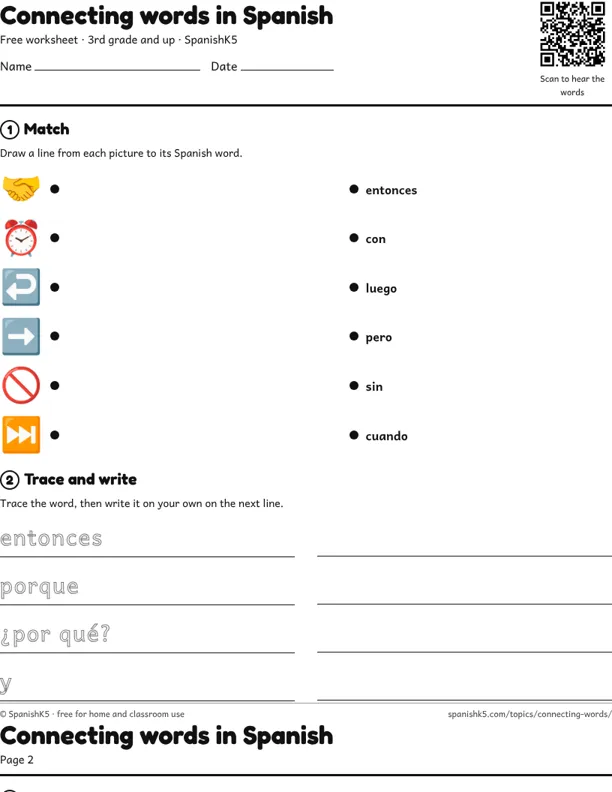
3 pages · US Letter · answer key included. Page 1 has matching and trace-and-write. Page 2 has circle-the-word and a word search or drawing. Page 3 is the answer key.
The QR code in the corner opens this page, so your child can hear the words while they work.
Free, no email needed. More printables: Spanish worksheets by grade.
Clap once for each connecting word as you say this chant we wrote.
Spanish speakers use pues and bueno all the time to start a sentence, the way English speakers say well or so. You'll also hear o sea, which means I mean, especially from young people. They aren't on this page's word list, but kids will notice them right away when they listen to native speakers.
Play the sentence-stretch game: one person says a short sentence, the next adds a connecting word and a new idea. Tengo un perro… → …y se llama Max… → …pero no le gusta el agua.
Connecting words is part of 3rd grade Spanish, 2nd grade Spanish.
Porque. To ask why, say ¿Por qué? (two words, with an accent).
Pero.
Y. Before an i sound it becomes e: padres e hijos.
O. Before an o sound it becomes u: siete u ocho.
Por qué (two words, accent) asks why. Porque (one word, no accent) means because.